
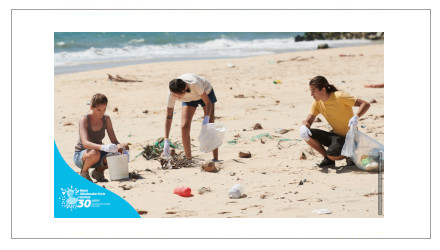
Recovering plastic from seas and oceans is only the beginning. Through MSCA Staff Exchanges, the CUPOLA project developed and tested a new technology to sort contaminated marine plastic waste – so we can convert it into what we need most.
Every year around 32 million tonnes of plastic waste are generated in the EU – that’s roughly the equivalent of 3,000 Eiffel Towers or 128 Coliseums. A large portion ends up in our waterways, destroying marine life and polluting the planet we depend on.
Our ecosystems cannot keep carrying this load. This is why researchers from CUPOLA, a Marie Skłodowska-Curie Actions-funded project, are thinking one step beyond: how can we make sure this plastic is not just retrieved, but recycled properly and transformed into new, useful materials?
The CUPOLA team, assembled through MSCA Staff Exchanges, includes leading experts in engineering, chemistry and environment. By trialling various thermal and thermochemical recycling technologies, they confirmed marine plastic can become something more sustainable – such as valuable chemicals and fuels, or asphalt for our roads.
CUPOLA is one of the 824 ocean and water-related projects supported by the MSCA programme since 2014, with a total of €441 million in EU funding supporting the development of over 4,000 researchers in this area.
Coordinator Aneta Magdziarz, from the AGH University of Krakow, explained how this interdisciplinary project connected fields and experts to create a solution to one of today’s biggest environmental challenges.
A greener process for cleaner oceans
Across the world, the ocean cleanup movement is making big waves with governments, industries and NGOs as main actors. Through the #EUBeachCleanup , the European Commission brings together institutions, NGOs and everyday heroes to clean up beaches, rivers and lakes.
“Collecting plastic waste from seas and oceans is relatively straightforward. The real challenge is sorting and recycling it, because it contains many different types of plastic and it is often contaminated with sand, salt and other debris – which makes recycling difficult,” said Aneta.
The idea for CUPOLA came from Aneta’s colleagues Jiawei Wang and Chunfei Wu, based in the United Kingdom. Together, they set up a strong international consortium of 15 research institutes and dozens of experts, including universities in Asia with world-class laboratories and infrastructure.
Through knowledge exchange and cooperation over four years, CUPOLA researchers developed a sorting technology which separates different strands of plastic with a purity above 95% – the level generally required for high-quality recycling.
But sorting is only the first step. To understand which plastic can be turned into which products, researchers set up specific focus groups on different thermochemical conversion technologies. These included gasification, which converts carbon-rich materials into a combustible gas mixture known as syngas; and pyrolysis, a thermal decomposition of organic materials at high temperatures (between 300-700 degrees) in the absence of oxygen or air.
“We then complemented this work with process modelling and economic analysis to assess how feasible the overall approach could be in practice, and the results were very encouraging,” said Aneta.
Giving plastic waste a new lease of life
The very thing that makes plastic so durable – its toughness and resistance to chemicals – is also why it is so polluting, with most taking centuries to decompose. But gasification and pyrolysis can break it down into its molecular form, so it can be rebuilt into new plastics – or even transformed into something new.
“Chemical recycling is one of the easiest and most promising routes for reusing marine plastic waste. It can turn this waste into high-value products such as chemicals,” explained Aneta.
But the list goes on: CUPOLA researchers found marine plastic could also become functional carbon materials, CO2 capture systems, refinery-compatible hydrocarbons, sustainable composite materials, nanotubes and even asphalt – although some of these routes require costly technologies and depend on the types of plastic available locally.
According to Aneta, CUPOLA built the knowledge, experience and results that constitute an excellent research foundation which could be brought closer to real-world application by a larger European initiative on marine plastic recycling.
“The next step would be to build a pilot-scale facility to test whether our assumptions hold true under real operating conditions – this would be important to achieve a higher technology readiness level. But I think we already showed that by working together we can make real progress on this challenge,” she said.
Sharing knowledge and shaping future cooperation
The international cooperation and mobility enabled by MSCA Staff Exchanges created a truly unique setting for CUPOLA researchers. They were able to organise long-term visits at partner institutions, learn new methodologies, gain first-hand experience of new technology and get a broader perspective on their field and future careers.
This was especially true for PhD students and early-career postdoctoral researchers, Aneta explained: “For them, travelling to China and learning new methods was a priceless experience. It helped them broaden their skills, use the results in their doctoral work, build stable collaborations and even change their perspective in some things.”
With the project due to wrap up in February, Aneta is already looking ahead to what’s next. CUPOLA’s results opened the door to new lines of research and especially to continued cooperation with her partners in the consortium.
“We are preparing a related proposal for an MSCA Doctoral Networks project, which would allow us to support a new generation of PhD students. We also successfully secured national funding for a new project on the thermochemical conversion of biomass waste from the food industry. Although we encountered several challenges, the project was absolutely worth it,” she said.
In this sense, CUPOLA’s legacy extends far beyond marine plastic recycling. It created the skills, networks and trust that will continue to strengthen EU-based innovation and technological capacity to successfully protect and restore our oceans’ health in the years ahead.
picture: © European Union, 2026. Source: DragonImages, Canva.